
Property owners and city leaders are under pressure from every direction: rising insurance premiums, higher energy costs, and growing expectations around safety.
Most don’t realize one of the most effective risk-reduction tools is already standing on their property.
It’s the light pole.
Insurance Risk Is Often an Infrastructure Problem
Slip-and-falls, vehicle collisions, vandalism, theft, and disputed claims share one common thread: visibility.
Poor lighting doesn’t just increase the likelihood of incidents—it also makes them harder to defend. When there’s no footage, no timestamps, and no objective record, claims escalate quickly.
This is why insurers increasingly look at lighting quality, coverage, and surveillance when assessing risk.
Smart Lighting Changes the Risk Equation
Drop Data’s integrated lighting and security model addresses risk at the source.
Instead of layering cameras onto buildings and hoping coverage overlaps, security is embedded directly into the lighting grid—where visibility already matters most.
Key advantages include:
- Consistent illumination that reduces blind spots
- Elevated camera placement for broader coverage
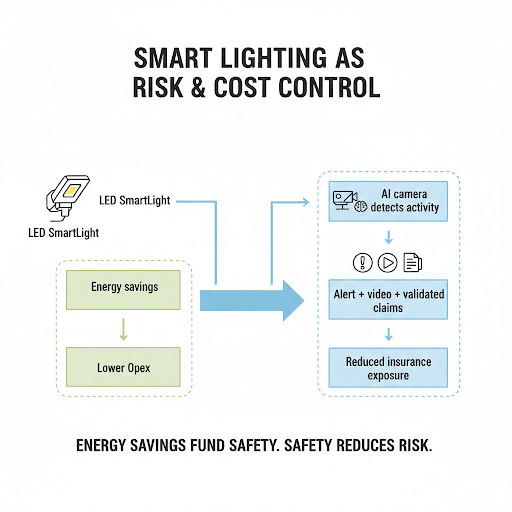
- AI alerts that detect motion and anomalies
- Recorded evidence to validate or dispute claims
Together, these factors can support property and casualty insurance savings of 5–20%, depending on the site and insurer.
Snapshot: How Smart Lighting Impacts Insurance Outcomes
| Risk Factor | Traditional Setup | Smart Lighting |
| Visibility | Inconsistent | Uniform, daylight-quality |
| Incident detection | After the fact | Real-time AI alerts |
| Evidence | Often unavailable | Time-stamped video |
| Claims disputes | High | Reduced |
| Insurance premiums | Rising | Potentially reduced |
Energy Savings Make the Math Work
Unlike standalone security systems, smart lighting often pays for itself through energy savings alone.
Modern LED SmartLights reduce energy consumption by up to 62% and maintenance by ~40%.
In large facilities—ports, campuses, parking assets—this translates into hundreds of thousands of dollars in operational savings per year.
That means risk reduction isn’t an added cost. It’s an operational upgrade.
Real-World Proof at Scale
In public infrastructure deployments, replacing legacy “light trees” with fewer, smarter LED fixtures delivers:
- Lower total wattage
- Better illumination
- Reduced electrical load
- Integrated security—without new poles
This combination is why many municipalities view smart lighting not as a capital expense, but as a long-term financial hedge against rising costs.
Why This Matters Now
Insurance markets are tightening. Energy costs are volatile. Public expectations for safety are rising.
Smart lighting sits at the intersection of all three.
A modern platform transforms outdoor infrastructure into a measurable financial and safety asset, delivering:
- Immediate energy ROI
- Ongoing operational intelligence
- Documented risk reduction
The smartest properties won’t ask if they should upgrade lighting.
They’ll ask:
“Why didn’t we do this sooner?”
FAQ
How does smart lighting reduce insurance risk?
Smart lighting reduces insurance risk by improving visibility, deterring crime, detecting incidents early, and capturing video evidence that supports claim validation and dispute reduction.
Can smart lighting lower property and casualty insurance premiums?
Yes. Properties with smart LED lighting that integrates security and AI alerts may qualify for 5–20% reductions in property and casualty insurance premiums, depending on insurer criteria.
Why do insurers care about outdoor lighting quality?
Insurers evaluate lighting quality because poor visibility increases accidents, crime, and liability claims, while smart lighting improves safety conditions and reduces incident frequency.
What role does video evidence play in insurance claims?
Video evidence helps verify incidents, prevent fraudulent claims, shorten investigations, and reduce legal exposure, thereby making properties lower risk for insurers.
Does smart lighting pay for itself?
Yes. Smart lighting often pays for itself through energy savings (up to 62%), reduced maintenance costs, and lower insurance exposure, making it both a safety and financial strategy.
People Also Ask
Can lighting really affect insurance premiums?
Yes. Better lighting reduces accidents, crime, and liability claims. Properties with smart lighting and integrated security may qualify for insurance premium reductions of 5–20%, depending on risk assessments.
How does smart lighting reduce liability risk?
Smart lighting improves visibility, detects incidents in real time, and captures video evidence—helping validate claims, prevent disputes, and reduce legal exposure.
Why do insurers care about outdoor lighting systems?
Insurers evaluate lighting because poorly lit properties have higher rates of injuries, theft, and claims, while smart lighting lowers incident frequency and improves loss prevention.
Is smart lighting considered a security system?
Smart lighting is not just a security system—it combines illumination, cameras, and AI alerts into a single infrastructure platform that enhances safety while delivering energy and operational savings.
What types of properties benefit most from smart lighting?
Cities, ports, parking facilities, campuses, HOAs, and large commercial properties benefit most, given their scale, visibility needs, and exposure to safety and insurance risks.