
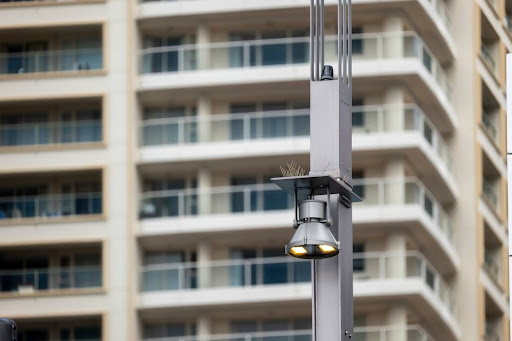
For decades, outdoor lighting was treated as a sunk cost—necessary, expensive, and largely invisible once installed. A pole went up, a bulb turned on, and the only question was whether it worked.
That model is now obsolete.
Modern cities and commercial operators are discovering that lighting can be one of the most powerful pieces of infrastructure they own—when it combines high-efficiency LED lighting, integrated security cameras, and AI-driven alerts into a single system.
The Hidden Problem With “Traditional” Outdoor Lighting
Across U.S. cities, ports, parking facilities, and campuses, 70% or more of outdoor lighting still relies on high-pressure sodium or metal halide fixtures.
These legacy systems create four compounding problems:
- Energy waste – Fixtures consume 2–3× more power than modern LED alternatives
- Poor visibility – Yellow, uneven light reduces recognition and situational awareness
- High maintenance costs – Bulbs, ballasts, and inspections never stop
- Zero intelligence – Lights can’t detect, record, or alert when something goes wrong
The result: cities overspend on power, underperform on safety, and lack evidence when incidents occur.
The New Model: Lighting That Sees, Thinks, and Responds
A modern approach flips the model by turning every light pole into a connected AI node.
At the hardware level, high-efficiency LED luminaires dramatically reduce energy usage—often by up to 62% compared to legacy lighting.
But the real breakthrough comes from what’s embedded inside the light.
Optional integrated security cameras and sensors feed into a smart light AI-powered platform that delivers:
- Motion-based alerts
- Object detection (people, vehicles)
- Remote visibility across entire properties
- Time-stamped video evidence when incidents occur
Instead of reacting after something happens, cities gain real-time situational awareness—without adding separate poles, cameras, or monitoring systems.
Snapshot: What Makes Smart Lighting Different?
| Feature | Traditional Lighting | Smart Infrastructure |
| Energy usage | High | Up to 62% lower |
| Visibility | Uneven, low CRI | Daylight-quality illumination |
| Security | None | Integrated cameras + AI alerts |
| Maintenance | Reactive | Remote diagnostics |
| Insurance impact | Neutral | Potential 5–20% P&C reduction |
Why This Matters for Public Safety
Better lighting alone improves safety. Smarter lighting changes outcomes.
Integrated cameras mounted at optimal elevation provide better coverage than wall-mounted systems. AI alerts flag unusual activity before damage escalates. And recorded evidence helps validate claims and reduce liability exposure.
In Collier County, Florida, replacing traditional streetlights with intelligent LED systems resulted in:
- 62% lower energy costs
- 40% lower maintenance costs
- 60% reduction in carbon emissions
Those savings compound year after year—while safety improves at the same time.
The Strategic Shift City Leaders Are Making
Forward-thinking city managers are no longer asking:
“How much does this lighting cost?”
They’re asking:
“What can this infrastructure do for us?”
With a modern approach, lighting becomes:
- A security asset
- An energy efficiency engine
- A risk-reduction tool
- A data platform for smarter decisions
That’s not a lighting upgrade.
That’s infrastructure evolution.
FAQ
What is AI smart street lighting?
AI smart street lighting combines high-efficiency LED lights with integrated cameras, sensors, and artificial intelligence to improve visibility, detect activity, send alerts, and reduce energy and maintenance costs.
How does smart street lighting improve public safety?
Smart streetlights improve public safety by delivering brighter, more uniform lighting, detecting motion or unusual behavior, and providing real-time alerts and video evidence to enable faster response times and incident resolution.
How much energy can cities save with smart LED streetlights?
Cities can reduce outdoor lighting energy consumption by up to 62% by replacing high-pressure sodium or metal halide lights with modern LED smart lighting systems.
Do smart streetlights include security cameras?
Yes. Smart streetlights can include optional, discreetly integrated cameras that monitor activity, record video, and support AI-based alerts—without requiring separate poles or standalone security systems.
Why are smart streetlights considered smart city infrastructure?
Smart streetlights function as connected infrastructure nodes that deliver energy efficiency, public safety monitoring, real-time data, and long-term operational savings—far beyond basic illumination.
People Also Ask
What is a smart streetlight?
A smart streetlight is an LED light fixture equipped with sensors, cameras, and connectivity, enabling cities to monitor activity, optimize energy use, and improve public safety through AI-driven alerts and remote management.
How do smart streetlights help cities save money?
Smart streetlights reduce electricity consumption by up to 62%, lower maintenance costs through remote diagnostics, and decrease liability risks—turning lighting from a fixed expense into a long-term cost-saving asset.
Are smart streetlights part of smart city infrastructure?
Yes. Smart streetlights act as connected infrastructure nodes that support energy efficiency, public safety monitoring, data collection, and operational intelligence across cities and public spaces.
Do smart streetlights increase surveillance?
Smart streetlights can include optional integrated cameras, but they are typically deployed to improve safety, visibility, and incident response—not mass surveillance—while complying with local privacy policies.
What problems do traditional streetlights cause?
Traditional streetlights consume excessive energy, require frequent maintenance, provide poor visibility, and offer no security or data capabilities—making them costly and ineffective for modern cities.